
Elmore's Former Owner Chain
A backward chain begins with a verified current deed. Each earlier transfer is a separate link. For every step, capture the grantor, grantee, date, instrument type, book and page, and the full legal description. Keep a working timeline, and require the legal description to stay consistent as the names change.
| Transfer Date | Grantor to Grantee | Deed Type | Book/Page |
|---|---|---|---|
| Newest verified filing | Seller's exact indexed name to present grantee | As labeled and read in the instrument | Copy exact citation |
| Prior acquisition | Earlier seller to the newest deed's grantor | As recorded | Copy exact citation |
| Earlier link | Repeat through each former owner | Note estate, tax, or quitclaim context | Copy exact citation |
| Pre-online link | Continue in books or predecessor records | Read the original text | Preserve volume and page |
This layout keeps every instrument visible. A quitclaim, estate deed, tax-related filing, or corrective instrument gets its own row. Nothing is forced into a simple sale story. A mortgage or lien may explain an event. It becomes an owner-transfer row only when a deed conveys the interest. Add a confidence note to each row. A direct deed-to-deed match with the same legal description is stronger. A shared surname or street address carries less weight.
When acreage changes, test whether the older tract was split, combined, or partly conveyed. When a subdivision appears for the first time, find the recorded plat. Then connect its lot and block back to the parent tract. Estate language may require the probate file and the representative's authority. Those details come before the next deed makes sense. Tax proceedings can add a certificate, redemption, or court action between apparent owners. Keep those events on the timeline. Just do not call each one a conveyance. This method preserves gaps instead of hiding them. It shows which prior owners rest on recorded instruments. It shows which names remain leads for more research.
Reconstructing Elmore Prior Owners
Start with the Elmore Probate index and its search controls. The index supports name, date-range, book/page, party-role, Starts With, and instrument-type filters, per its official instructions. Those controls let you trace a parcel's chain of ownership backward. Work from grantee to grantee. Each deed names the buyer of record. From there, look up that name as an earlier seller. Keep stepping back one transfer at a time.
The full reach of the online coverage period is unknown. So mark the point where the digital records run out. Avoid assigning a guessed cutoff year. Every backward search through Elmore County property records begins at the official Elmore Probate portal, displayed above.
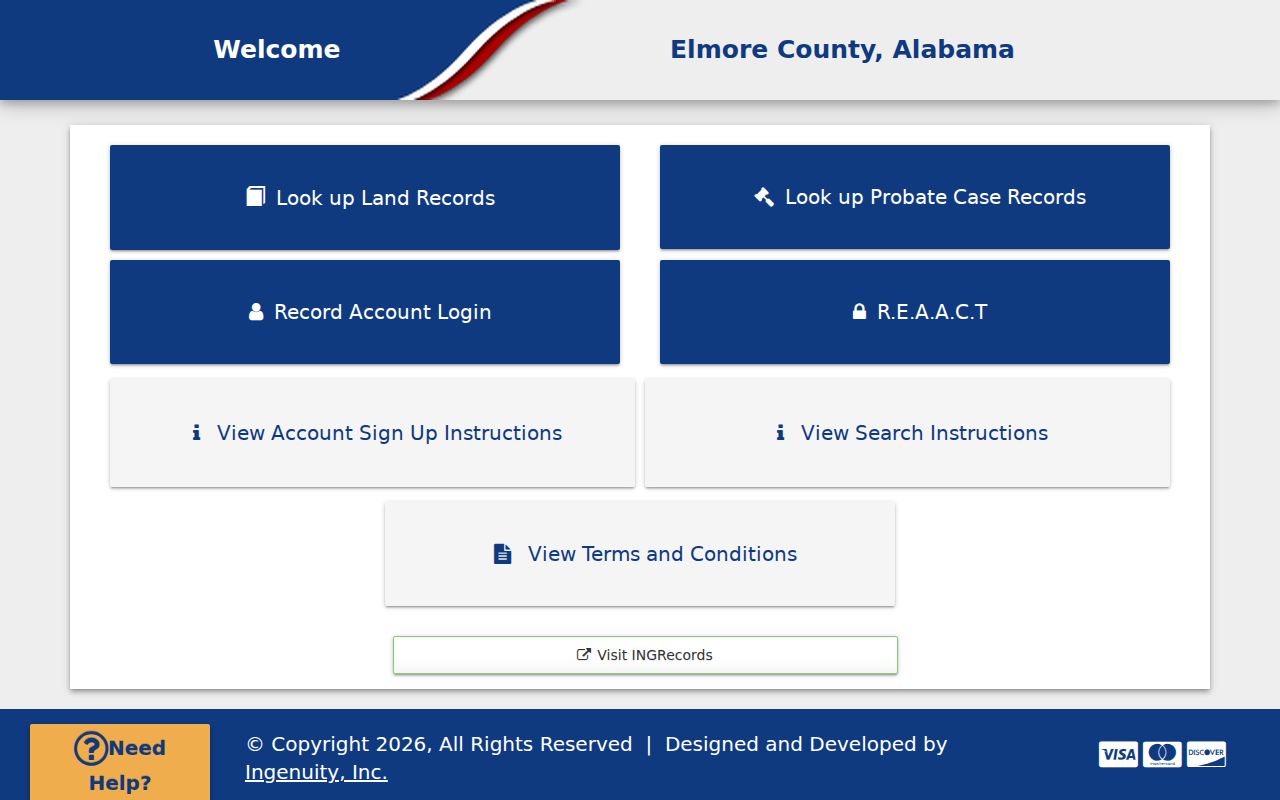
The landing page supplies the county entry point. The chain itself still depends on role, date, instrument, and legal-description checks at each step.
- Confirm the present acquisition deed and copy its grantor, grantee, date, reference, and legal description.
- Search the grantor as a grantee in an earlier date range.
- Compare parcel number, legal description, lot and block, acreage, and cross-references.
- Add the matching transfer to the timeline and repeat with its grantor.
- At the digital limit, ask for the relevant reverse index and deed book at the courthouse.
- Grantor
- The party that transferred the interest in that deed.
- Grantee
- The party that received the interest in that deed.
- Chain of title
- The ordered sequence of recorded ownership instruments for the same land.
- Reverse index
- An index organized to help find a party on the receiving side of a conveyance.
- Quitclaim and warranty
- Different forms of conveyance whose exact promises must be read in the document.
How Far Elmore Prior Owners Reach
The published instructions do not state a first online year. Nor do they say whether all early index volumes are scanned. The earliest surviving Elmore deed book also goes unnamed. That absence matters. An empty web result may mean the date precedes online coverage. The name may have been indexed differently. Or the image may require another access step.
Elmore Probate offers public viewing and printing stations in Room 100 of the old courthouse. Call 334-567-1140 extension 5084. Ask for the earliest online index and the older grantor and grantee books. Ask about any microfilm and the copy process. Mail goes to PO Box 280, Wetumpka, AL 36092.
The cutoff is not verified. Do not assign a year to Elmore's online chain. Continue through the public station, deed books, archives, or predecessor counties.
Legal Clues to Elmore Former Owners
Older deeds rarely carry a modern street address. The county GIS fields include subdivision, book/page, lot/block, parcel identifiers, acreage, and a metes-and-bounds description. An official sample card uses the brief form “438 ACRES SEC 2 T18 R17.” That shorthand is a clue, not the deed itself. Preserve spacing, leading zeroes, and punctuation in parcel numbers. A county sample parcel number reads 15 01 02 0 001 002.000. Rural land may lack a stable address. Use section-township-range in the Alabama land-record search. If the land later became subdivision lots, build a crosswalk from the early description to plat, lot, block, parcel, and street address.
Former Elmore Owners Before 1866
Elmore County was formed on February 15, 1866. Its land came from Autauga, Coosa, Montgomery, and Tallapoosa counties. A prior-owner chain that reaches before that date may cross into one or more of those jurisdictions. State and federal land systems may hold the original instrument. A later Elmore book may not repeat it. County formation is a routing fact. It is not evidence of a transfer. Match the old tract description and period to the predecessor county, then return to the actual deed or patent before adding any person to the chain.
Wetumpka Clues to Elmore Past Owners
Wetumpka burned repeatedly. Documented fires struck in 1845, 1852, 1902, and 1908. Flood, railroad, and county-seat history add further twists, which is why a modern address may not map neatly onto an older description. Search historic sources with period terms like east side, west side, courthouse, railroad depot, river, and town lots. They are clues, never deed substitutes. The Library of Congress Weekly Herald record covers the Wetumpka title from 1898 to 1927 and lists related newspaper titles. Sale notices, probate notices, sheriff sales, road projects, and lost-deed notices can surface a name or a date. A newspaper proves publication, not the legal conveyance. Retrieve the deed, order, or plat it mentions.
Estate Links Between Elmore Prior Owners
An estate transfer is where a former-owner chain most often snaps in Elmore County. Land can move through a will. It can also pass through a tax proceeding or a court order instead of a plain sale. Tie the estate case to the representative's recorded deed. Restricted vital records can help eligible requesters prove identity. A certificate, though, never conveys land by itself.
Tax-sale excess-fund petitions in county commission minutes can expose a parcel number. They can also surface a transaction clue that a simple owner search misses. Follow that clue into Revenue delinquency material and the Probate filing. Also check any Circuit Court redemption or quiet-title case. The minute entry is a pointer, not the final ownership instrument.
Historic Elmore Former Owner Sources
Several channels feed historic former-owner work in Elmore County. The Probate public station and mailed requests supply local instruments. Alabama Archives and FamilySearch deepen the historical collections. The Birmingham Public Library's Elmore guide rounds up census, birth and death, newspaper, map, cemetery, and local-history leads. It serves researchers tracing families across Wetumpka, Millbrook, and Tallassee. Local libraries can help with online access or regional context. None of them, however, serves as a deed custodian.
A narrow county public-record request can surface an existing index entry or a historical record. List names, an approximate date, book and page, the parcel or legal description, and the desired format on the county form. The form carries Alabama-residency certification and administrative-fee language. Ask the right custodian before filing anything broad.
Note: Record each source's as-of date and confidence because an index, tax card, map, and historic notice answer different questions.
Limits on Elmore Ownership History
False links come easily in ownership history. Similar names, spelling drift, remarriage, trusts, entities, estates, lot splits, and address changes can all mislead. A deed index is only a finding tool. Confirm each owner against the instrument itself. Blank plat or deed-summary fields prove nothing either way.
Tracing an individual Elmore County deed is far narrower than building a full backward chain. Gaps matter most when they touch a purchase, inheritance, fraud claim, boundary dispute, or clear-title decision, and that is when a title professional or an Alabama attorney earns their fee.
Lawful historical use. Prior-owner records support title research, estate work, and house history. Never use the names or addresses to track, harass, or harm a living person.